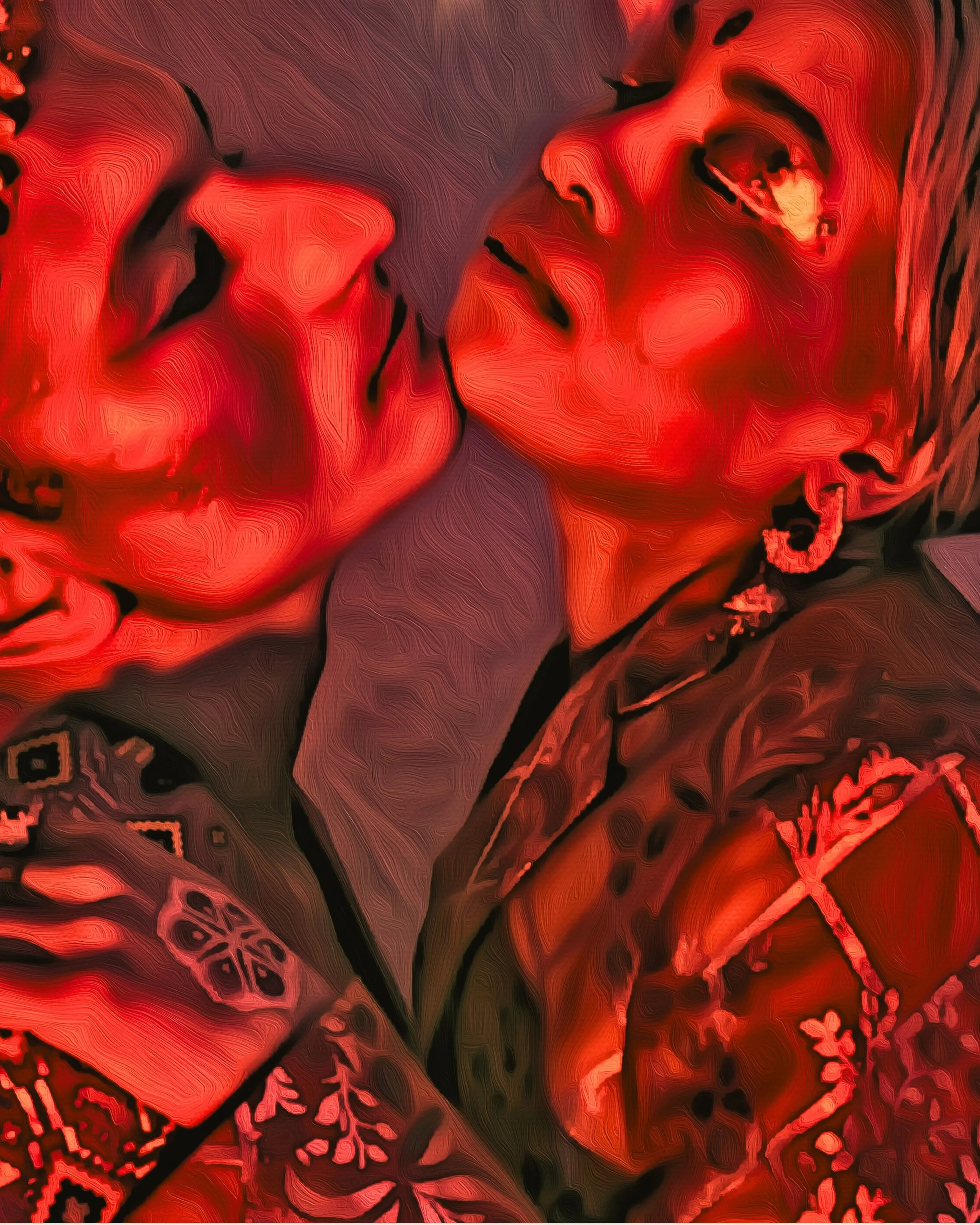
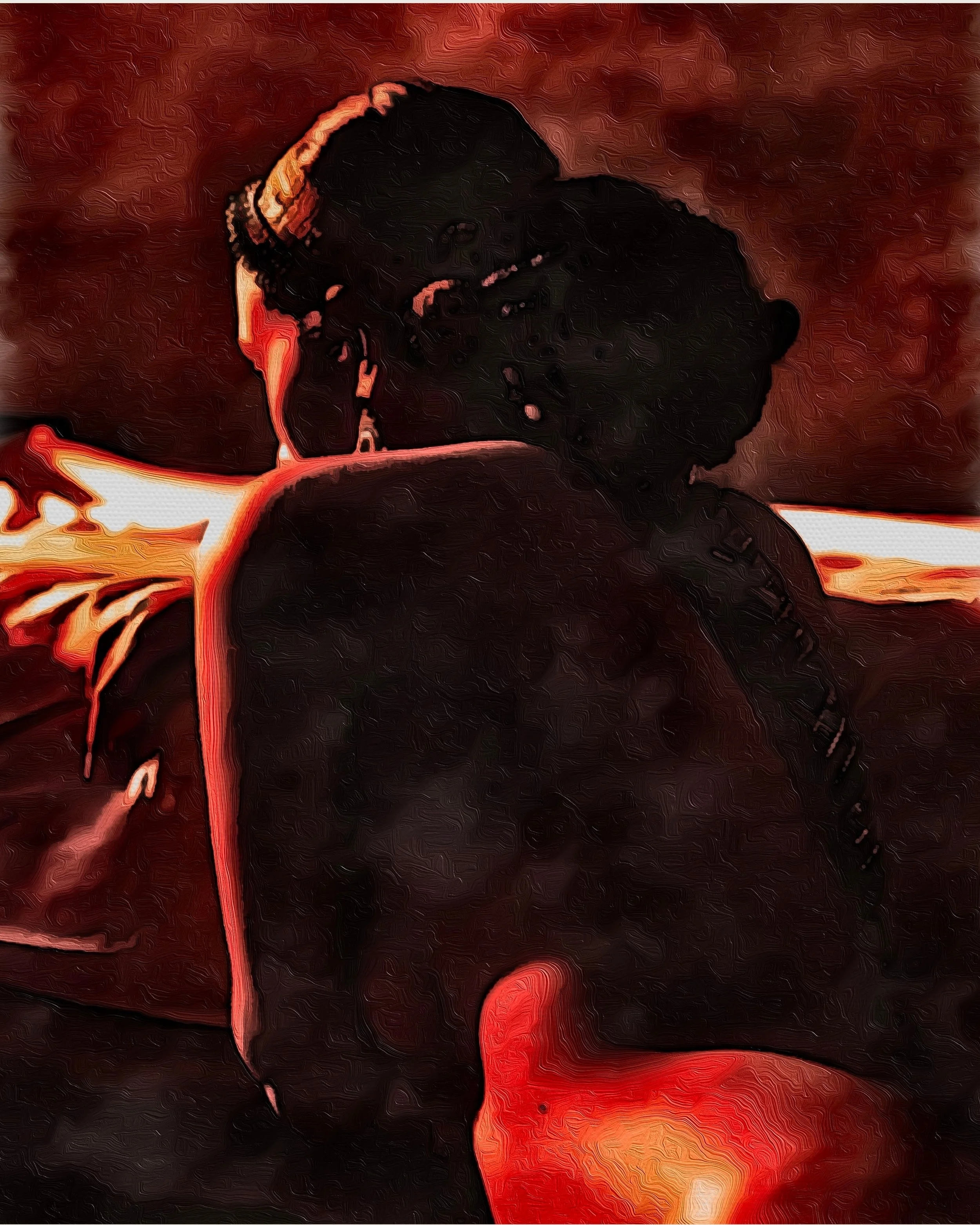
BANGALI LOVE
(2025)
Written in Collaboration With the Ashok Jain Gallery (December 2025).
In a moment when diaspora identity is marketed as aesthetic, when “representation” is flattened into algorithms and palatable multiculturalism, Bangladeshi-American artist Laureen Andalib (they/them, b. 1995, BFA ‘17 Cornell, MDes ‘23 Harvard, U.S. Humanities Prize Recipient) insists on something far messier, riskier, and more luminous. Their new illustration series, Bangali Love (2025), is not simply a visual exploration of intimacy, it is a reclamation, a refusal, and a rewriting of what Bangali bodies— especially queer, polyamorous, diasporic bodies— are allowed to feel, archive, and mythologize.
To understand the defiant tenderness of Bangali Love, it helps to understand the world that nurtured it: Studio Somatics (সোমা) (@studiosomatics), the design and movement studio Andalib founded at Harvard Business School in 2022. In a place more accustomed to venture capital than visceral vulnerability, Andalib carved out a somatic laboratory where trauma, censorship, liberation, and lost legacies collide. Studio Somatics is not a studio in the traditional sense; it is a practice of return. A philosophy that sees the body—not as documents or diagnoses— but as diasporic nostalgia and the first site of truth-telling.
By interrogating the entanglements of material, movement, psyche, and land, Studio Somatics pushes art back into the realm of the sentient. Its mission is world-building, and not the escapist kind. Andalib’s vision is to world-build through chaos—through the bruised terrains of history, through the unspeakable wounds of the South Asian subcontinent, through the suppressed stories of the lived experience.
The studio’s methodology insists on reconciliation not as a policy stance but as a bodily desire: a desire to revive what was erased, to heal what was silenced, and to embody what could not previously be spoken.
Bangali Love emerges from this ethos. It is not merely a series; it is a somatic cartography, tracing the poetic and emotional geographies—the ancestral roots from which multiple lovers’ diasporic love continually unfurls. But these regions are not backdrops. They are textures, hauntings, and gravitational forces. They shape the series’ central question: What does it mean to reclaim Bangladeshi queerness not as exile but as inheritance?
Eroticism as Political Technology
In Bangali Love, Andalib uses the RGB codes of the Bangladeshi flag as both palette and pulse. This is not patriotism. It is a strategic, intimate re-coloring of the nation’s visual language. Where the flag has historically symbolized sovereignty, suffering, and liberation through war, Andalib reinterprets it to mark sovereignty through touch and liberation through desire.
The works transform real-time intimacy—bodies entangled in the mundane holiness of daily life—into dreamlike terrains that feel painterly, even mythic. Edges blur, time dissolves, and figures soften into heat and shadow. This blur is not abstraction for abstraction’s sake; it is protection. A refusal to reproduce the documentary gaze that has long sought to surveil, expose, voyeurize, and discipline queer bodies, especially in South Asian contexts where moral policing is not merely social, but systemic.
The blurred surface becomes a site where documentation and obscurity coexist: a sanctuary against cultural mechanisms that weaponize visibility. In this sense, Andalib’s work participates in a lineage that includes the feminist video artists of the 1970s—artists who turned cameras on themselves to insist that female embodiment could be authored from within, not through patriarchal frames. However, Andalib adds to this lineage a distinctly Bangladeshi, distinctly diasporic vocabulary.
Bangali Love as Radical Refusal
One of the most provocative aspects of Bangali Love is its treatment of polyamory and non-traditional relationship structures—not as Western counter-cultural experiments but as forms of Bangali practice, Bangali risk, and Bangali joy. In doing so, Andalib confronts a deep hypocrisy: South Asian cultures often pride themselves on their emotional expansiveness, familial collectivism, and poetic devotion, yet remain intensely punitive about eroticism. Especially in the context of Bangladesh’s conservatism and religious roots, the series re-questions what it means to feel, love, and desire beyond socio-structural norms.
By foregrounding queer polyamory, Andalib challenges the sanitized narratives of immigrant respectability. The series pushes against the idea that South Asian diaspora life must be disciplined into heteronormative, monogamous frameworks in order to be legible, survivable, or successful (Polysecure, Jessica Fern, 2020). Instead, the work reframes tenderness as an act of sovereignty. The softened forms in Andalib’s images are not anonymized; they are mythologized. They become self-directed icons—stories told on one’s own terms, rather than stories told about us in whispers or court documents.
This self-mythologizing is not escapism. It is a historical correction. For too long, the archives of Bangladeshi art, nationalism, and cultural memory have excluded queer lives—not because they did not exist, but because they threatened the moral clarity of nation-building narratives. Bangali Love refuses this erasure. It asserts that Bangladeshi queerness is not a Western import, not a generational rebellion, not a diaspora confusion, but a birthright.
Diaspora as Distance– and Return
What makes Andalib’s project unusually resonant is the way it navigates diaspora not as a wound but as a vantage point. Many diasporic artists wrestle with distance from the homeland by preserving it in nostalgia. Andalib, however, uses distance as a clarifyer. From their vantage point in the U.S., they can see both the violences and the beauties of Bangladeshi cultural formations—and they choose to intervene. They prompt the viewer to consider: What does it mean to love in proximity? To love across borders, across ruptures, across histories heavy with silence? The series does not answer these questions. It embodies them.
Andalib is not trying to prove that queer Bangali love “fits” into the national narrative. They are insisting that it expands the narrative. That it is already there, pulsing beneath the surface, waiting to be acknowledged.
Between Censorship & Self-Determination
The most striking achievement of Bangali Love is perhaps its balance of vulnerability and strategy. The series exposes—but only on its own terms. It reveals—but selectively. It gestures toward the erotic—but refuses to serve voyeuristic consumption. In this way, it is both deeply personal and deeply political. This balancing act mirrors the fundamental tension faced by queer artists in restrictive cultural environments: how to be seen without being captured; how to document without being endangered; how to declare one’s existence without offering it up as spectacle. Through blur, color, composition, and somatic resonance, Andalib devises an answer: visibility can be soft. Resistance can be lush. Love can be a weapon and a balm all at once.
The series becomes a pedagogical tool, teaching viewers to read the space between bodies—the space where desire, risk, and memory converge. It urges us to think of intimacy as a knowledge system and affection as a political position.
A New Chapter in Bangladeshi Art
Ultimately, Bangali Love marks a new chapter in Bangladeshi art—not because it centers queerness, but because it refuses to isolate queerness from the ecological, ancestral, and emotional terrains of being Bangladeshi. Andalib’s work insists that queer Bangali love is not marginal— it is foundational. It is a testament to survival, but more importantly, to celebration.
In a world that often demands our wounds as proof of authenticity, Andalib instead offers softness, multiplicity, and self-determined joy. They remind us that the most radical act is not to document our suffering but to design our liberation. And perhaps most importantly, they give us permission—to feel, to desire, to remember, to imagine—beyond the boundaries we inherited.